A Gnostic-Structural Critique of the Catholic Regime-Form
This is a critique of hierarchy, authority-claims, interpretive monopoly,
disciplinary machinery, salvation-control, and the Catholic institution
presenting itself as the authorized body of Christ.
No restraint is granted to the institution. Mercy is reserved for the
kneeling person; the throne gets the blade.
third witness not indexed // recover the phrase from witness residue
This text critiques institutional religion, sacred authority, hierarchy,
guilt, sin, dogma, salvation-control, and religious power structures.
It speaks directly against Catholic regime-form without pretending the
machinery is identical to the ordinary believer trapped inside it.
Target Note
This is not aimed at Catholic people. Not the person praying honestly.
Not grief carried through ritual. Not Mary, saints, beauty, devotion,
or sincere faith.
The target is not the believer kneeling in good faith. The target is
the throne built around their kneeling.
Short Thesis
The Catholic Church may be the exact structure Christ warned people about.
This is not a soft disagreement with decorative incense around it. It is
an accusation that Rome learned the grammar of Christ, painted His face
on its jurisdiction, and then called resistance to the office resistance
to God.
Not because every Catholic is evil. Not because every priest is false.
Not because every ritual is empty. Not because beauty, prayer, saints,
Mary, confession, or devotion have no value.
But because a living rupture became an institution. A warning became a
crown. A crucified man became a throne. A path of relation became a
system of permission.
From a Gnostic view, this is the false mask: sacred power that does not
openly oppose God, but wears God's face.
citations exposed // interpretation marked as blade-work
Visible Source Apparatus
Sources on the Table, Knife Beside Them
The page separates text, citation, and accusation. A cited fragment is
not the whole argument; it is the relic placed under pressure.
Matthew 23, KJV
The Christian text itself contains attacks on religious gatekeeping,
public holiness, and authority that blocks the kingdom while claiming
to guard it.
Gospel of Thomas
The Gnostic pressure is interior recognition: truth encountered as
awakening, not merely as permission granted by the authorized channel.
Apocryphon of John
The archonic pattern is a limited ruler claiming total status. This
page reads Catholic jurisdiction through that mythic suspicion.
archon residue detected in the authorized channel
Intercepted Texts
Signals Under the Floor
Matthew 23:13, KJV
"Ye shut up the kingdom of heaven against men."
Christ's accusation is not atheism. It is gatekeeping: sacred office
becoming a locked door.
Gospel of Thomas 3
"The kingdom is inside of you, and it is outside of you."
Gnosis does not begin with permission from an office. It begins as
recognition, interior and cosmic at once.
Apocryphon of John
"I am God and no other god exists except me."
The archon is not merely wicked. He is a local ruler mistaking his
limited order for the whole of being.
two witnesses visible // third route sealed
Witness Residue
Two Signals Left in the Open
The core argument can be read straight through. These side channels
follow two feminine witnesses the regime-form cannot easily absorb:
Mary Magdalene and Sophia.
A third witness is present only as residue. The map refuses to name her here.
III
stations of the critique
Signal Map
Choose a Breach
Do not read straight. Trace a leak, open a file, skip rooms, return changed.
A warmer path through the archive: scripture, art, and reflection before the critique cuts deeper.
Ford Madox Brown, Jesus Washing Peter's Feet, c. 1852-1856.
John 13:14
"Ye also ought to wash one another's feet."
The first Christian image here is not command from above, but service
from below. Let that sit beside every claim of sacred rank.
Contemplate service
Where does authority kneel? Where does it protect itself from
kneeling? A church can preach humility while arranging the room so
everyone knows who may speak.
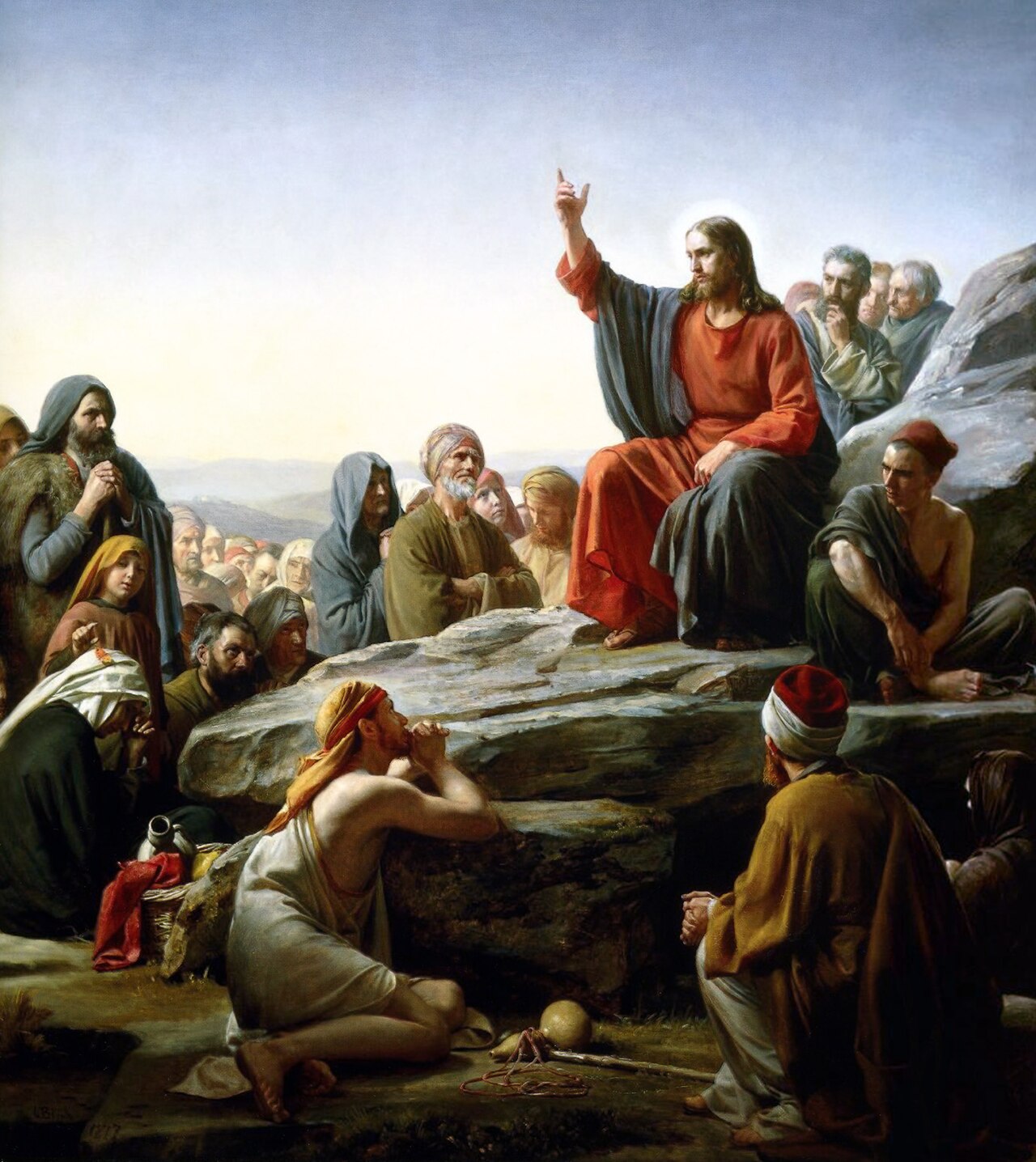
Carl Bloch, The Sermon on the Mount, 1890.
Matthew 5:3
"Blessed are the poor in spirit."
The sermon opens with those who do not look like institutional
winners. The kingdom is announced as reversal before it is system.
Read the reversal
Ask what a regime has to do to turn blessing into credential,
poverty of spirit into compliance, and mercy into paperwork.
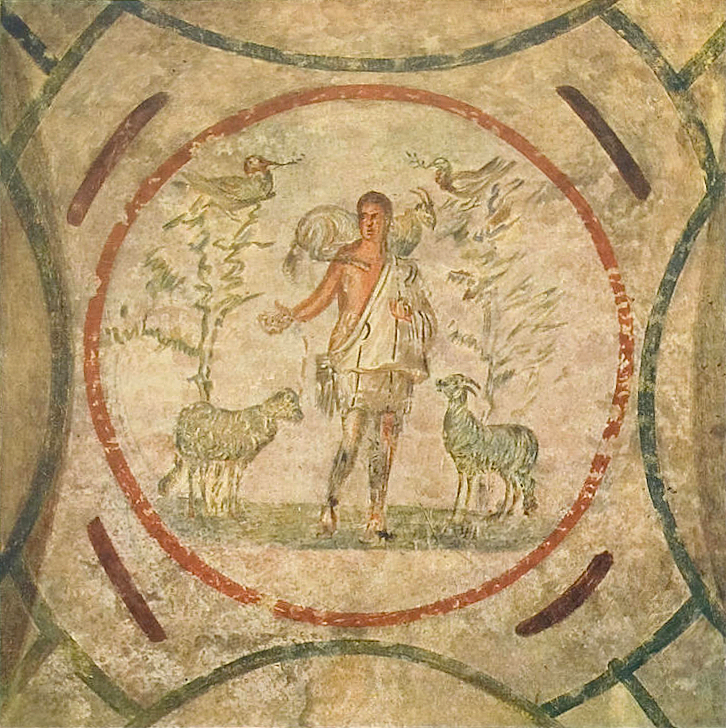
Good Shepherd fresco, Catacomb of Priscilla, 3rd century.
John 10:11
"The good shepherd giveth his life for the sheep."
Shepherd language becomes dangerous when the shepherding office
forgets sacrifice and remembers only enclosure.
Examine the fold
A fold can shelter. A fold can also become a fence. The difference
is whether love is protecting life or protecting control.
Antiveduto Gramatica, Mary Magdalene at the Tomb of the Risen Christ.
John 20:18
"Mary Magdalene came and told the disciples that she had seen the Lord."
The witness comes before the committee. The living encounter arrives
before the interpretive office can manage it.
Open the witness lens
This is where Christian devotion and Gnostic suspicion touch: a
woman sees, speaks, and becomes a problem for those who expect
truth to arrive through the approved channel.
lux alienawitness before officethe fold is not the skythe key hidden in the chest
first rupture: temple-machine loses signal
Door 04
Christ as Rupture
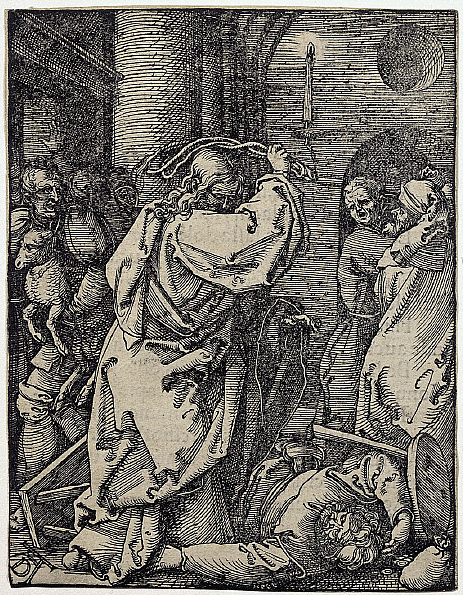
Albrecht Durer, Christ Driving the Moneychangers from the Temple. Public-domain image via Wikimedia Commons.
Christ appears as rupture.
He breaks sacred gatekeeping. He challenges religious authorities.
He exposes holiness as performance. He touches the impure. He places
life above law. He reveals that God is not owned by the temple-machine.
Then the Church takes that rupture and administers it.
A prophet walks in the desert. A priesthood builds an office.
A mystic speaks in parables. A council writes boundaries.
A crucified man exposes empire. An empire adopts his symbol.
The living fire becomes jurisdiction.
mask behavior: speaks as God, fears questions
Door 05
The False Mask
The false sacred power does not need to announce itself as the enemy
of God.
"I preserve God."
"I protect the truth."
"I am tradition."
"I am safety."
"I am the only path."
"I am the body."
"Without me, you are lost."
It does not oppose God. It wears His face.
The regime does not need to defeat Christ. It only needs to become
indistinguishable from Him in the minds of the faithful.
Then criticism of the institution becomes rebellion against God.
UNSEAL: counterfeit sacred identity
The mask does not need to lie about every holy thing. It only needs
to make every holy thing pass through its name. Once the institution
becomes the required face of God, the soul is trained to fear the
loss of God whenever it resists the office.
Fuse yourself to God, then call resistance impiety.
local ruler claiming total sky
Door 06
Yaldabaoth
Yaldabaoth is not merely evil. He is ignorant authority.
He receives power from a higher source, then forgets where it came from.
He sees his own realm and mistakes it for the whole. He possesses
borrowed light and calls it his own. He creates order and mistakes
order for ultimate truth. He rules locally and imagines himself absolute.
The Catholic Church becomes Yaldabaothic not because it has no light.
It becomes Yaldabaothic because it has fragments of light and mistakes
custody for ownership.
Open the ledger of light
The Church has beauty. It has ritual. Memory. Mystics. Art. Devotion.
Genuine seekers. Real encounters with God.
That is exactly why the critique must be careful.
The Church is not dangerous because it has no light. It is dangerous
because it mistakes custody for ownership.
SOURCE ERROR: Wisdom Before the Ruler
Clue word 02: before
Sophia is the wound in the architecture: wisdom prior to the ruler,
light before the administrator, depth before the local throne. In
the myth, Yaldabaoth has power because something higher shines
through him. His error is not possession of light, but the claim
that borrowed light proves his sovereignty.
That is the deeper accusation against sacred regime-form: it takes
custody of a fragment and calls custody origin.
map begins biting the traveler
Door 07
Dogma as Topology
Dogma is not always worthless.
A doctrine can be a map. A ritual can be a vessel. A tradition can
preserve memory. A symbol can open perception.
But dogma becomes demiurgic when it forgets it is a tool and begins
acting as the condition of God's presence.
The map then claims to be more real than the relation. The border
becomes holier than the soul.
TRACE SIGNAL: when maps become cages
A map helps until it becomes the wall. Doctrine helps until it
claims that anything outside its drawn border is less real, less
human, less loved, or less reachable by God. The cage is built
when the symbol stops pointing and begins policing.
chain of custody disguised as cosmos
Door 08
God Is Not Jurisdiction
The Catholic structure implies a chain:
God
Christ
Church
priesthood
sacrament
believer
This is not just administration.
It teaches an ontology: divine life as something distributed through
authorized channels.
Against that:
Truth is not a license.
Grace is not institutional property.
The soul is not saved by being processed through the correct office.
Possessing a temple is not possessing God.
Preserving a doctrine is not owning truth.
Holding ritual authority is not owning grace.
OPEN UNDERCHANNEL: ontology of mediation
The question is not whether communities need forms, teachers, or
rituals. The question is whether being itself must be routed
through an office. When mediation becomes ontology, the channel
stops serving relation and begins owning it.
mercy kept behind the counter
Door 09
Jesus and Sin
The Church says Jesus was fully human yet without sin.
Fine.
But if sin means ordinary human burden, then Jesus did not bear
ordinary humanity.
And if Jesus truly bore ordinary humanity, then sin cannot mean every
form of fear, anger, rupture, weakness, desire, or limitation.
Jesus gets angry, and it is righteous judgment.
A wounded human gets angry, and it is pride.
Jesus challenges religious authority, and it is revelation.
A human challenges church authority, and it is rebellion.
Jesus breaks temple order, and it is holy.
A human questions the office built in His name, and it is heresy.
The Church universalizes Jesus as the standard, but reserves His
interpretive mercy for itself.
Sin can mean something real: cruelty, domination, betrayal of love,
refusal of repair, turning partial power into absolute power.
But if sin becomes a net thrown over ordinary creaturehood, then the
human being is condemned for being human.
Sin is not ordinary rupture. Sin is domination that refuses relation.
Sin is when a partial order crowns itself absolute over others.
UNSEAL: mercy reserved by authority
The regime can forgive itself in sacred language while naming the
wounded person's rupture rebellion. It can call Christ's anger
revelation and the abused person's anger pride. That asymmetry is
not doctrine. It is power protecting its interpretive throne.
Door 10
World Wearing Christ's Name
The Church claims to oppose "the world."
Yet as a regime, it mirrors the world's machinery:
rank, office, law, property, punishment, political alliance, control
of bodies, control of speech, control of interpretation.
The same world Christ exposed reappears wearing Christ's name.
do not confuse the kneeler with the throne
Door 11
Sincere Practitioners
A kind person inside a system does not prove the system is kind. A
beautiful ritual inside a hierarchy does not prove the hierarchy is
divine. A holy person inside a regime does not prove the regime is holy.
The critique is structural, not personal.
WITNESS FILE: The Apostle They Would Not Route
Clue word 01: witness
Mary Magdalene is the rejected witness-thread: the one who sees,
speaks, and is contested. In Gnostic memory, her knowledge becomes
a problem for male authority because it breaks the assumption that
sacred interpretation must descend through the approved hierarchy.
Her presence sharpens the critique: if the institution claims to
own the meaning of Christ, then the woman who knows outside the
sanctioned channel becomes a threat, not because she lacks light,
but because she reveals that light was never institutional property.
empire can baptize its own architecture
Door 12
Deeper Accusation
Maybe the problem is not only bad priests, bad bishops, bad popes,
bad councils, or bad eras.
Maybe the deeper problem is the attempt to turn awakening into empire.
To turn gnosis into permission.
To turn Christ into a border guard.
To turn mystery into doctrine.
To turn grace into jurisdiction.
To turn relation into obedience.
Clue word 03: office // the route opens where witness stands before office
Trace Third Witness
Sealed Field
Three words are scattered through the witness files and residue.
Recover the phrase to expose the hidden route.
A candle in a prison does not make the prison heaven.
final file: the face was learned
Door 13
Final Rebuke
The regime says:
"Come through us to reach God."
The Gnostic reply:
"That is exactly what the jailer would say if the key were hidden in my chest."
The regime says:
"We are the body of Christ."
The Gnostic reply:
"Or you are the mask that learned His face."
The regime says:
"Without us, you may be lost."
The Gnostic reply:
"The higher divine does not need fear to be recognized."
The regime says:
"Obey the sacred order."
The Gnostic reply:
"No partial order gets to crown itself absolute."
OPEN LAST FILE: the mask learned His face
The final horror is not open opposition to Christ. It is imitation.
The regime studies mercy, speaks its grammar, preserves its relics,
paints its icons, guards its texts, and then positions itself between
the living soul and the living God. The mask is convincing because
it learned the face by proximity.
Closing Blade
The Church is not merely a flawed messenger of Christ.
It may be the captured mask of the very regime-form Christ came to expose.
The warning label became a throne. The rupture became an office. The cross
became a seal.
And the living God was mistaken for the institution that claimed to manage Him.
Pull-Quote Fragments
Shareable Shards
The target is not the believer kneeling in good faith. The target is the throne built around their kneeling.
The false sacred power does not need to announce itself as the enemy of God. It only needs to wear God's face.
The Church is not dangerous because it has no light. It is dangerous because it mistakes custody for ownership.
God is not jurisdiction.
Truth is not a license.
Grace is not institutional property.
Dogma becomes demiurgic when it forgets it is a tool.